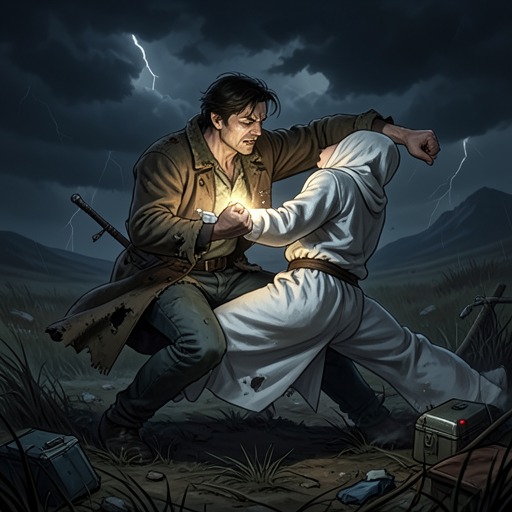
“I’m wrestling with the angel”
Jacob's LadderYasha’s declaration that he is wrestling with an angel turns an immediate, bodily struggle into an image shaped by biblical story, fear, and bereavement. Its meaning changes as the scene moves between hands holding him in place and the imagined presence of Zeyde: the contest first feels overwhelming, then becomes a trial Yasha believes he must survive until morning, and finally a struggle in which he is promised companionship. The expression holds those shifts together without resolving the scene’s uncertainty about whether Zeyde is present as a ghost or as a figure in Yasha’s memory.
The Biblical Image and Its Personal Meaning
Yasha identifies his struggle through the story of Yaakov, addressing Zeyde as he says, “I‟m wrestling with the angel, just like Yaakov in the story.” The comparison gives a name and shape to what is happening to him, but the scene does not present the biblical allusion as distant explanation. Yasha speaks it in a moment of distress, while lashing out with a foot and feeling hands clamp down on it. The sacred image is therefore bound to physical resistance: the language of wrestling belongs both to the story he recalls and to the immediate contest his body seems to be undergoing.
The image also makes the struggle feel multiple. Yasha complains, “God seems to have sent more than one for me,” converting the hands restraining him into the “angels” he imagines he must face. The line carries a rueful edge, but it does not make the ordeal seem easy; his humor appears alongside the shuddering fear that precedes his recognition of Zeyde. The phrase thus accommodates two registers at once: a familiar religious story and a desperate attempt to describe an experience that feels too large for one opponent.
A Struggle Measured Until Morning
The scene develops the metaphor by giving the contest a deadline and a consequence. Yasha remembers that Zeyde is dead and understands himself to be wrestling until morning in order to win. The challenge is not described as a debate or a purely spiritual conflict. Hands move over his body, hold him still, and pull a strap tight around his chest. That contrast makes the language of wrestling sharply concrete: the imagined struggle unfolds alongside restraint, and Yasha’s words register a body being held even as his mind gives that experience a mythic form.
His confidence breaks into an appeal: “I‟m not strong enough.” Asked what he means, he says, “I can‟t hold on until morning,” and fears that “The angels will beat me.” These statements clarify what winning means within the image: continuing to hold on through the night. They also make the metaphor less a declaration of heroic certainty than an expression of threatened endurance. Yasha can recognize the shape of a story about wrestling and still doubt that he has the strength to complete his own struggle.
Zeyde as Companion and Uncertainty
Zeyde’s place in the expression is intimate from its first appearance: Yasha whispers his name before invoking Yaakov. Later, as he drops his head back, he imagines it resting on Zeyde’s shoulder and feels that everything will be okay. That moment of comfort is immediately unsettled when hands move over him and he remembers that Zeyde is dead. The repetition gives the scene its emotional pulse: imagined closeness offers relief, while the return of that fact brings grief back into the struggle.
When Yasha again calls for Zeyde and admits that he is not strong enough, Zeyde’s voice answers firmly, and someone takes Yasha’s hand. The reassurance is precise: “I‟ll be right here. I won‟t let you lose.” It answers Yasha’s fear in the same terms as the wrestling image, promising presence rather than denying the contest. The scene leaves the source of that presence open. Yasha wonders whether Zeyde might be a ghost, but the text does not confirm that explanation; it shows the voice and the hand alongside Yasha’s awareness of Zeyde’s death.
The Expression’s Narrative Work
The phrase matters because it changes as Yasha’s circumstances and sense of support change. At first, wrestling with the angel is a recognition of ordeal; the “more than one” angels give his fear a wry, plural shape. When Yasha recalls that Zeyde is dead and imagines having to last until morning, the metaphor becomes a test he fears losing. Zeyde’s answer then redirects its meaning: Yasha still faces a struggle, but the promise that he will not lose makes endurance feel shared rather than solitary.
The scene does not settle the difference between religious image, grief, memory, and supernatural possibility. Instead, it lets them occupy the same moment. Yasha draws on Yaakov’s story to speak of struggle, recalls the physical facts of hands and a strap, and turns to Zeyde for comfort despite knowing that he is gone. The expression’s force comes from that overlap: it makes a frightening, bodily ordeal speakable while preserving the uncertainty and longing that surround it.